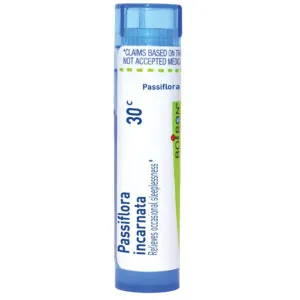




Common name: Passionflower
Latin name: Passiflora incarnata
Where to find it: It is found in Central America, especially in Mexico, as well as in Bermuda and the Caribbean.
Properties: A plant recognized for its calming and soothing properties
Passion flower isn’t just a flower
Passiflora incarnata is much more than just a stunning ornamental flower – it’s a plant with exceptional calming and soothing qualities. At Boiron, we respect these plants every step of the way as we transform them into healthcare solutions so that you can truly benefit from all of their properties.
The Aztecs’ soothing remedy
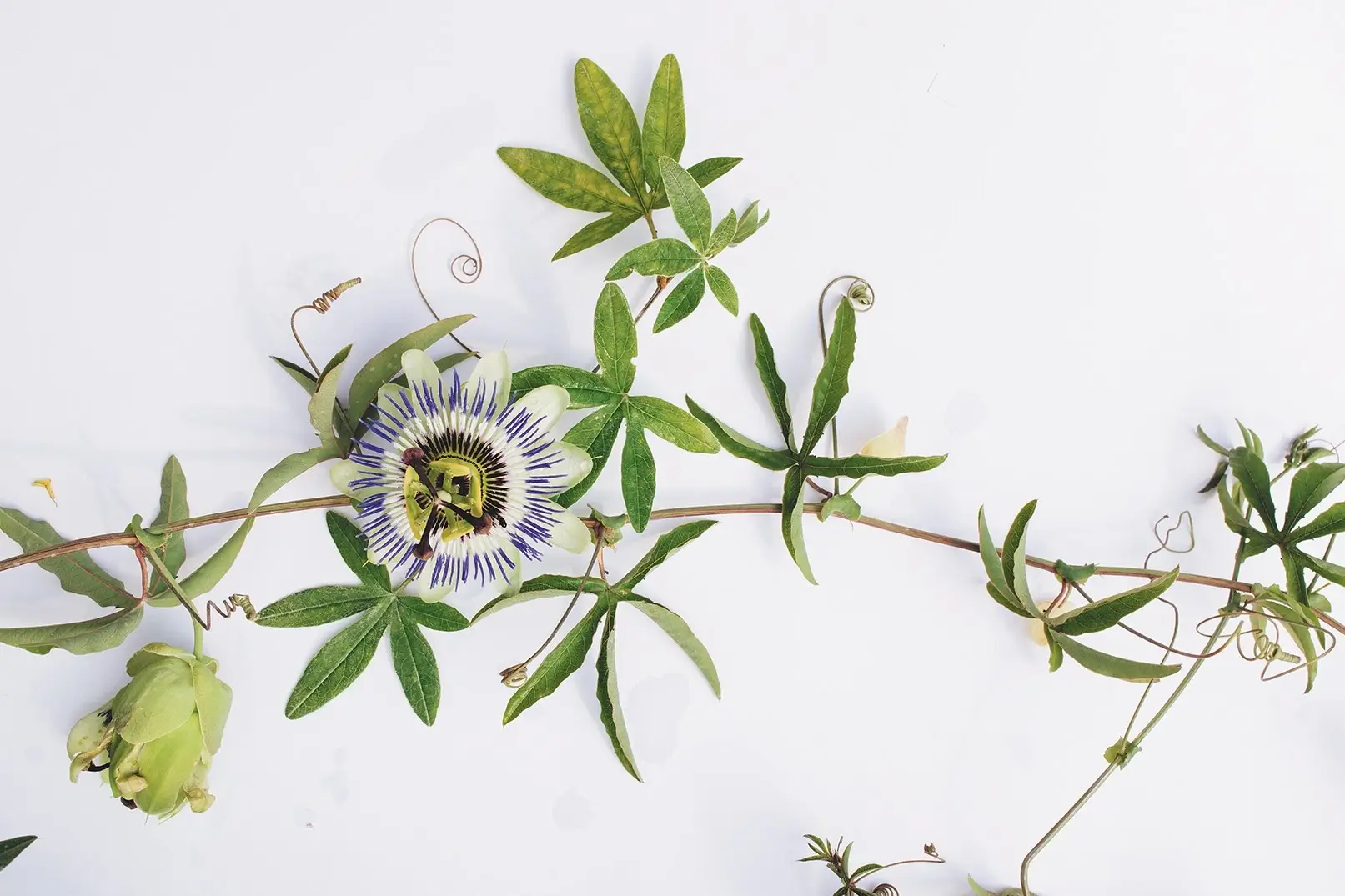
When the Spanish conquistadors arrived in Mexico in the 16th century, the Aztecs were already using passion flower for its benefits, particularly its sedative effect. The Jesuits saw all the symbols of the Passion of the Christ in the plant and named it “Passiflora incarnata”, meaning “flower that incarnates the passion”. They believed that the pistils represent the nails used during the crucifixion, and the filaments the crown of thorns. The 5 stamens, which often have a red tint, are thought to depict the 5 wounds Jesus suffered before his death. Initially, the passion flower was only used for its refreshing fruits when it was brought back to Europe by the Spaniards, and it was only in the 19th century that American doctors discovered its sedative effect. Passion flower has been listed in the French Pharmacopoeia since 1937.


Where does Passiflora incarnata grow?
Also known as maypop or wild apricot, Passiflora incarnata is native to the south-east of the United States, where it grows in the wild. It is also found in Central America, particularly Mexico, as well as Bermuda and the West Indies. Today, it is also grown for its medicinal virtues and ornamental flowers in North Africa and around the Mediterranean. In France, it grows in milder climates – in the South of France, of course, and in Anjou, Morbihan and west Calvados.
What does Passion flower look like?
There are more than 500 species of passion flower, but Passiflora incarnata, or maypop, offers the most known health benefits. It shouldn’t be confused with Passiflora edulis, the species which provides edible passionfruit. Passiflora incarnata is a climbing plant that can grow up to 9 metres tall. When in flower, its beautiful petals are accentuated by the crown of colourful and fragrant filaments that surround the pistil and the stamens. As well as its medicinal virtues, Passiflora incarnata is also prized for its delicious orangey-yellow fruits.


Calming and soothing effects
Passiflora incarnata contains a number of active ingredients including flavonoids, β-carboline alkaloids, maltol, phenols and essential oils. These active ingredients give Passiflora incarnata its calming and soothing properties, meaning it is traditionally used in phytotherapy for insomnia and anxiety. At Boiron, we only use fresh passion flowers that we pick in France in summer and we only ever use the leaves and flowers. As soon as they are harvested, they are quickly sent to our laboratories where they are immediately processed, to ensure they retain all properties and their key components.
Opinion of the WHO
The World Health Organization (WHO) describes traditional use of Passiflora incarnata as “a mild sedative for nervous restlessness, insomnia and anxiety”. It also describes its use in treating gastrointestinal disorders of nervous origin and its use in traditional medicine for dysmenorrhoea, neuralgia and nervous tachycardia. (1)

Written in collaboration with:
Dr. Khalil Taoubi
Ph.D. in pharmacognosy. Expert in botany, toxicology, and pharmacopoeia.
(1) Wichtl M, Anton R. Plantes thérapeutiques. Ed. Tec & Doc – EM inter, 1999, 47-51. Eymard L.
(2) Arnica montana, de nos grands-mères à nos comptoirs, Thèse pharmacie, Marseille, 2017.
(3) Pinkas M., Pinchon T.M. Arnica montana L. (Asteraceae) ; in Cornillot : Acupunture & Médecine traditionnelle chinoise, Phytothérapie & Aromathérapie, Homéopathie. Ed. Fison-Roche, 1996, 77-83.
(4) For antioxidant properties: Paumier A, Verre J, Tribolo S, et al. Anti-oxidant Effect of High Dilutions of Arnica montana, Arsenicum Album, and Lachesis Mutus in Microglial Cells in Vitro. Dose Response. 2022 Jun 29 ;20(2):15593258221103698.
(5) For lactones: Drogosz J, Janecka A. Helenalin – A Sesquiterpene Lactone with Multidirectional Activity. Curr Drug Targets. 2019;20(4):444-452. .
(6) For flavonoids and phenolic acids: Ganzera M et al. Quantitative analysis of flavonoids and phenolic acids in Arnica montana L. by micellar electrokinetic capillary chromatography. Anal Chim Acta 2008; 614: 196-200.
(7) Tutin T.G., Heywood V.H., Burges N.A. et al (1976) – Flora Europea – Cambridge University Press (G.B.)
(8) Monographie OMS ARNICA – 2007 : https://apps.who.int/iris/bitstream/handle/10665/42052/9789241547024_eng.pdf?sequence=3&isAllowed=y page 89