

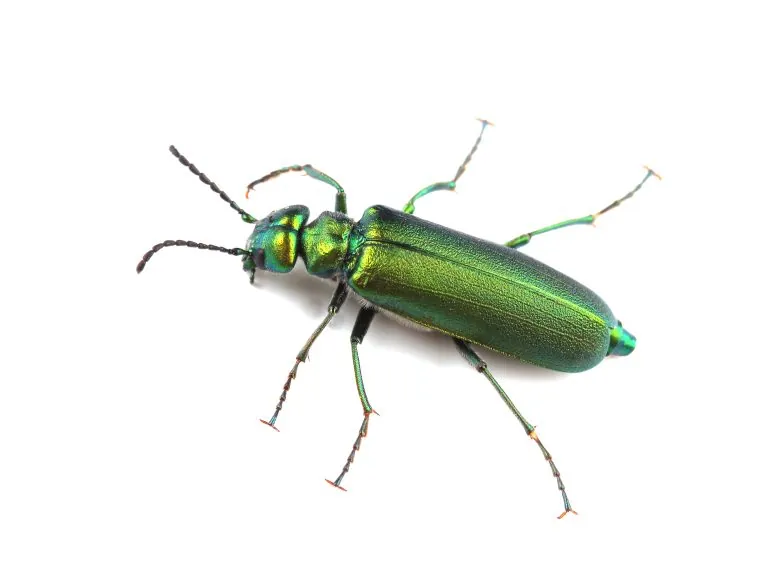
Native to parts of Europe and Asia, Lytta vesicatoria is a striking emerald-green beetle better known as the Spanish fly. Growing up to 2 cm long, this blister beetle feeds on other insects and is most noted for the potent substance it secretes — one that has drawn human interest for centuries.
Life isn’t easy for this blister beetle. A female lays between 2,000 and 4,000 eggs, but only a few will survive. She deposits them near solitary beehives or directly in the ground. Once hatched, the larvae latch onto the nearest host, typically a bee or grasshopper eggs. In this parasitic phase, they’re nicknamed “bee lice,” clinging to their hosts through several stages of development. Eventually, they shed their parasitic lifestyle and begin feeding on plants as independent adults.
Spanish flies are best known for secreting a potent substance called cantharidin. This toxin is so effective that it eliminates the beetle’s need for camouflage — predators think twice before attacking. Historically, the whole powdered insect, known as cantharid, has been used in various medicinal traditions. It was referenced in Hippocrates’ writings and featured in both Chinese and African herbal traditions. Most famously, it earned a reputation as an aphrodisiac in so-called “love potions” due to its effect on nerves in the bladder and pelvic area. However, because of its toxicity, internal use was eventually abandoned. Despite this, cantharid’s blistering properties continued to draw interest. Historical use of some forms of cantharid simulated the body to produce such intense results that the first homeopaths were curious to see if a highly diluted dose of it could be useful. From this, it was discovered that homeopathic preparations of cantharid could relieve blisters from burns and friction. Cantharid remains part of conventional medicine and is used in prescription topical treatments.
The Spanish fly is also used in homeopathic preparations called Cantharis (Kan-tha-ris). As an extremely diluted medicine, it helps to relieve the external symptoms that it causes at full strength — blisters with burning pain.*
Homeopathic Cantharis is available as a “blue tube” single medicine but can also be found in Boiron’s Hiking & First Aid Essentials Bundle.
Interested in learning more about the homeopathic uses of Boiron Cantharis? Watch this video featuring pharmacist Gary Kracoff, NMD, RPh.
*Claims based on traditional homeopathic practice, not accepted medical evidence. Not FDA evaluated.